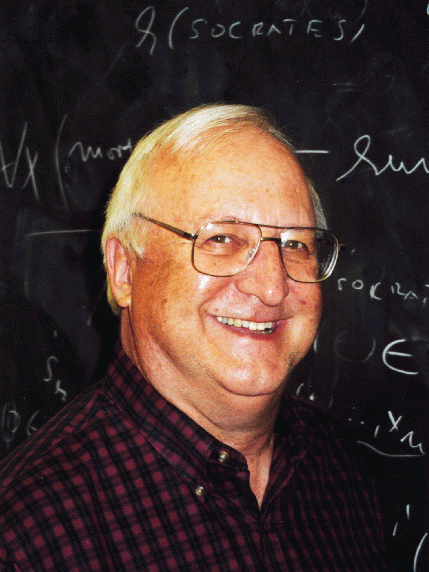
Office: 607 PGH
Office Phone: (713)-743-3462
The easiest way to reach me is by sending e-mail to klaus@math.uh.edu. You may also send me snail-mail via the Department of Mathematics, University of Houston, Houston, TX77204-3476.
First Info for my Fall Courses
Math 3330
2020FA_5331_linear
algebra.html
I was from 1980-1992 an
associate editor of the Zeitschrift für Mathematische Logik und Grundlagen der Mathematik which shortly after the Re-Unification of Germany became
Mathematical Logic Quarterly
Since June 1996, I am Managing Editor of the Houston Journal of
Mathematics.
I got quite interested in publishing issues:
At the Satellite Conference on Electronic Information and
Communication in Mathematics of the International Congress of
Mathematicians, Beijing, August 2002, I presented at Tsinghua University a paper
Paper:
The Web: Challenge and Opportunity for an Independent Journal.pdf
Slides:
Tsinghua_Talk.ppt
This article is contained in Springers Lecture Notes on Computer Science,
LNCS 2730, see
http://www.springeronline.com/sgw/cda/frontpage/0,10735,5-40109-22-7110736-0,00.html
At the joint meeting of the American Mathematical Society and Sociedad
Mathemática Mexicana, Houston, May 2004, I co-organized with Bernd Wegner
and Enrique
Ramírez de Arellano a special session on Problems and Issues in
Electronic Publishing. I presented the paper
Paper:
Some Recent Issues on the Business of
Journal Publishing: An Independent Point of View.pdf
Slides: Houston_Talk.ppt
This article is contained in "New Developments in Electronic Publishing of Mathematics", published by FIZ Karlsruhe http:/www.fiz-karlsruhe.de/
, for sales and distribution. Electronic files are available through EMIS,
The Electronic Library of Mathematics,
in Mathematical Collections and Conference Proceedings
Jim Pitman has created a homepage for this meeting at http://www.stat.berkeley.edu/users/pitman/houston04.html
and has added interesting links related to topics which have been
discussed at this conference.
I gave an invited talk at the Communicating Mathematics in the Digital Era (CMDE
2006) conference in Aveiro, Portugal August, 15-18
Slides:Aveiro_Talk.ppt
Paper: Implementing Electronic Access for an
Independent Journal:Technical Issues, Business Decisions, Legal Matters.pdf
This paper is included as a chapter in the book "Communicating Mathematics in
the digital Era" published by
K. Peters, ISBN 978-1-56881-410-0
For the JMM 2013 Joint Mathematics Meetings in San Diego I
co-organized with Steven Krantz (AMS) and Elizabeth Loew (Springer Verlag) a session on Topics and Issues in
Electronic Publishing
Slides:
San Diego Talk
Paper:
Author
Sponsored Journals
Proceedings are published
by FIZ Karlsruhe
http://www.emis.de/proceedings/TIEP2013/
A footnote in model theory: I proved 1966 that the variety of all algebras of a fixed type admits a model completion. Like in the case of fields, the models of the inductive hull (now called Kaiser hull) ) are algebraically closed. But what about the models of the projective hull? Robinson mentioned to me in 1971 that probably a whole new logic might be needed for characterizing those algebras. And indeed, the axioms of the projective hull are exactly what is now referred to as Clark's Equational Theory (1978) which is central for Prolog. But interestingly enough, Mal'cev knew these axioms already (1962) as the axioms for locally absolutely free algebras. He also noticed completeness of these axioms, a fact that was rediscovered by Kunen about 25 years later.
Back to UH Home Page or UH Department of Mathematics
This page was updated on August 2, 2017